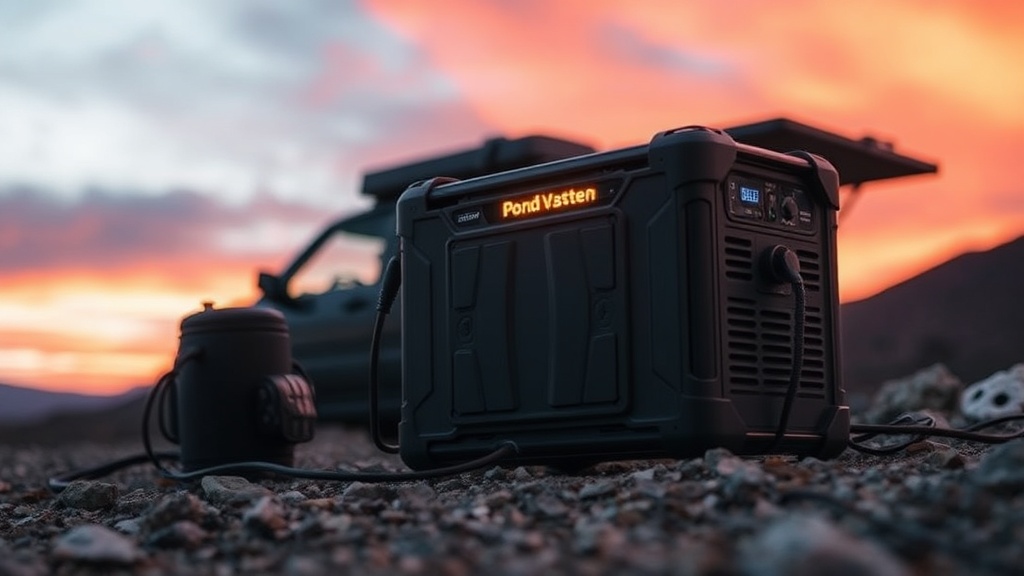
Why Your Portable Power Station Fails on Long Trips

Over 40% of portable power station users report that their battery capacity significantly underperforms compared to the manufacturer's advertised specifications during real-world use. This discrepancy often leads to unexpected blackouts in the middle of a trip, leaving families unable to charge phones, run portable fridges, or power essential lighting. This guide identifies the technical and behavioral reasons why your power station is failing and provides a systematic approach to calculating your actual energy needs so your next camping trip remains uninterrupted.
The Discrepancy Between Capacity and Usable Energy
The most common reason a power station fails is a fundamental misunderstanding of Watt-hours (Wh) versus Voltage (V). When you see a unit advertised as having 500Wh, that is the theoretical maximum energy storage. However, several factors immediately begin draining that capacity before you even plug in a single device.
The Inverter Tax
If you are using the AC outlets on your power station to plug in a standard wall plug—such as a coffee maker or a laptop charger—you are engaging the internal inverter. The process of converting DC (Direct Current) battery power to AC (Alternating Current) is not 100% efficient. Most mid-range units, like the Jackery Explorer series or EcoFlow Delta models, lose between 15% and 20% of their total energy just to run the inverter itself. If you are running a 60W device through an AC outlet, you are actually drawing closer to 70W of energy from the battery.
The Depth of Discharge (DoD) Limit
To protect the longevity of Lithium Iron Phosphate (LiFePO4) or Lithium-ion cells, most modern power stations have a built-in Battery Management System (BMS). This system will automatically shut the unit down before the battery is truly at 0% to prevent permanent cell damage. If your device shuts off when the screen reads "5%," it is actually performing as designed. Relying on that last 5% is a recipe for failure because that energy is often inaccessible.
Common Calculation Errors in Trip Planning
When I build my camping itineraries, I treat power requirements like a project budget. Most people estimate based on "average use," but camping requires planning for "peak load."
Ignoring Parasitic Loads
A parasitic load is the energy consumed by a device while it is "off" but still plugged in. For example, a portable fridge like a Dometic CF Series or an Alpicool unit consumes power continuously to maintain temperature. Even when the compressor isn't running, the internal electronics are active. If you do not account for this constant draw, your power station will deplete much faster than your spreadsheet predicts.
The "Peak vs. Continuous" Trap
Many camping appliances have a high startup surge. A small 12V heated blanket might only use 50W continuously, but when it first kicks on, it may require a much higher burst of current. If your power station's output limit is too low, the unit will trigger a safety shut-off, even if you have plenty of total capacity left. Always check the "Surge Wattage" of your devices against the "Peak Output" of your power station.
Environmental Factors That Drain Battery Life
Your power station does not exist in a vacuum; the environment around your campsite directly impacts its performance and efficiency.
Temperature Extremes
Batteries are highly sensitive to temperature. In high-heat environments, such as a desert campsite in Joshua Tree, the internal cooling fans of your power station must run more frequently to prevent overheating. This fan usage is an additional energy drain. Conversely, in cold weather, the chemical reaction inside the battery slows down, reducing the effective capacity. If you are camping in cold climates, you may find that a battery that worked perfectly in July is significantly weaker in October.
Solar Charging Inefficiency
Many families rely on solar panels to replenish their power stations during the day, but solar efficiency is often overestimated. A 100W solar panel rarely produces 100W of actual power. Due to the angle of the sun, cloud cover, and even the temperature of the panel, you are more likely to see an actual output of 60W to 70W. If your math assumes a constant 100W input, your battery will not be fully recharged by sunset, leading to a deficit the following morning.
For more information on maximizing your outdoor energy, see our guide on Solar Power Optimization: Keeping Your Van Fridge Running During Spring Heat Waves.
A Systematic Approach to Power Management
To ensure your power station survives a multi-day trip, you must move away from guesswork and toward a strict energy budget. Follow these three steps for every trip.
Step 1: The Inventory Audit
Create a list of every electronic device you intend to use. For each item, identify three numbers:
- The Rated Wattage: Found on the device's power brick or label.
- The Estimated Runtime: How many hours per day will it actually be running?
- The Connection Type: Will it use USB, 12V DC, or AC?
Step 2: The Calculation Formula
Use this formula to determine your total daily Watt-hour requirement:
(Watts × Hours of Use) ÷ Efficiency Factor = Required Wh
Example: A 10W LED lantern used for 5 hours.
(10W × 5h) = 50Wh.
Applying a 0.8 efficiency factor (to account for losses): 50 ÷ 0.8 = 62.5Wh per day.
Step 3: The Buffer Rule
Once you have your total daily Wh requirement, multiply it by the number of days you will be off-grid. Then, add a 25% "Safety Buffer." If your calculations show you need 400Wh for a two-day trip, your target capacity should be at least 500Wh. This buffer accounts for unexpected cloudy days, lower temperatures, or an extra hour of phone usage.
Optimizing Your Setup for Longevity
Once you are at the campsite, your behavior determines how long your power lasts. Use these tactical adjustments to stretch your energy reserves.
- Use DC Wherever Possible: Plug your phone chargers into the USB ports rather than the AC wall outlets. Use a 12V car-style plug for your portable fridge instead of the AC plug. This keeps the inverter off and preserves significant energy.
- Stagger Your Charging: Instead of running the coffee maker, the phone chargers, and the fan all at once, spread out your high-draw activities. This prevents hitting the peak wattage limit of your station.
- Manage Heat Exposure: Keep your power station in the shade and inside a ventilated area. If it is sitting in direct sunlight on a picnic table, the internal cooling systems will work overtime, draining your battery.
- Pre-Chill Everything: If you are using a portable fridge, ensure it is plugged into your vehicle's 12V outlet while driving to the campsite. This allows the unit to reach the target temperature using the car's alternator, so the power station only has to work to *maintain* the temperature rather than doing the heavy lifting of initial cooling.
By treating your power station as a finite resource rather than an infinite well, you can eliminate the anxiety of "running out" of power. Whether you are camping in the mountains or a state park, a calculated approach ensures that your lights stay on and your devices stay charged.