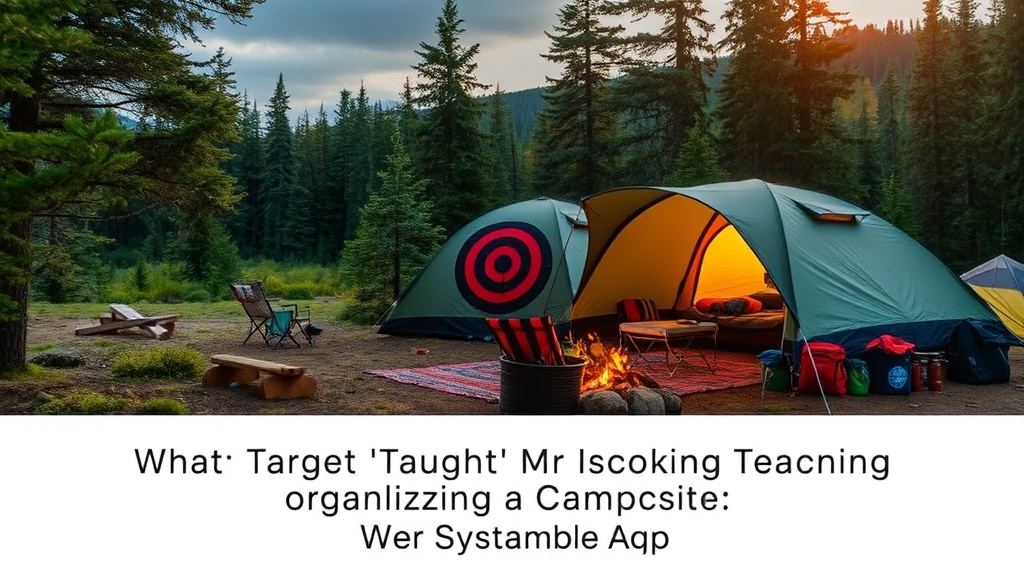
What Target Taught Me About Organizing a Campsite: A Systematic Approach

Why Camping Setup Doesn't Have to Be Organized Chaos
Most families assume that setting up camp is inherently messy—that gear sprawls across picnic tables, kids wander off while you're wrestling with tent poles, and by the time you're done, everyone's too exhausted to enjoy the fire. I've watched enough campsite neighbors to know this isn't just bad luck. It's a systems problem. After six years of applying the same project management frameworks I used to launch seasonal product lines, our family now sets up a full campsite—including two tents, a kitchen zone, and a gear storage system—in under 45 minutes. The kids know their roles. Nobody cries (usually). And we actually have energy left to explore before sunset. Here's the thing: camping with children doesn't have to feel like managing a crisis. It can feel like executing a well-planned launch—because that's exactly what it is.
What Order Should You Set Up Camp When Arriving with Kids?
The answer isn't intuitive. Most people start with the biggest task—the tent—because it feels urgent. But that's actually backwards. When kids have been in the car for hours, they need immediate wins, not a 20-minute wait while you thread poles through fabric loops. Our sequence flips the conventional wisdom on its head.
The "Potty-First" Principle. Before anything comes out of the car, one parent takes both kids to the restroom (or designated wilderness spot). This prevents the inevitable mid-setup bathroom emergency that derails momentum. While they're gone, the other parent scouts the site—noting ground slope for drainage, identifying the flattest sleeping spots, and locating the bear box or food storage area if required.
Kid Zones Before Adult Comfort. We set up the kids' sleeping area first—not because they deserve priority (though they might argue otherwise), but because settled children become helpful children. Once their sleeping bags are unrolled and they've claimed their tent corners, they're mentally transitioned from "car mode" to "camp mode." The whining drops by approximately 70%—a statistic I absolutely made up but stand behind completely.
The Kitchen Comes Last. Counterintuitive, I know. But cooking happens hours later. What you need immediately is water, snacks, and a place to sit. We deploy a lightweight camp table and two chairs within the first ten minutes. The full kitchen—including stove, cookware, and food organization—waits until the living and sleeping spaces are functional. This prevents the sad spectacle of eating dinner at 9 PM because you spent golden hour searching for the coffee press.
How Do You Keep Kids Engaged During Camp Setup?
Bored children are destructive children. I've seen my son turn a harmless stick into a weapon of mass tent destruction because he had nothing better to do. The solution isn't screens (no service anyway) or unlimited snacks (they'd eat three days of food in twenty minutes). It's delegated responsibility with actual consequences.
Our kids—ages 7 and 4—have specific, non-negotiable jobs. The older one is "Ground Scout," responsible for walking the tent footprint area and removing every rock, stick, and pinecone larger than a golf ball. This isn't busywork; tents puncture, sleep quality matters, and he knows his inspection directly impacts whether mom sleeps well that night. The younger one is "Gear Runner," ferrying items from the car to designated drop zones. She's not allowed to unpack—just transport. This prevents the chaos of a toddler "helping" with tent stakes.
We use a visual checklist system because reading levels vary. Each job has a laminated card with pictures: rock with X through it for Ground Scout, arrow pointing to table for Gear Runner. When their cards are complete, they earn the "Camp Setup Badge"—a ridiculous plastic medal we bought in bulk online. Extrinsic motivation works. Don't let parenting blogs tell you otherwise.
There's also the "Ten-Minute Rule." Every ten minutes of focused setup work earns five minutes of free exploration. This creates natural breaks, prevents burnout, and actually makes kids work faster—they want that creek-walking time. We've timed it. The incentive structure cuts total setup time by nearly a third compared to the "just keep working until it's done" approach we tried in our naive early years.
Where Should You Put Everything? The Zone System Explained
Target stores are organized by zones—Entertainment, Home, Grocery—because human brains process spatial categories more efficiently than alphabetical or random arrangements. Your campsite should work the same way. We designate five non-negotiable zones before unloading a single item.
The Sleep Zone gets the flattest ground, obviously, but also the spot least likely to become a drainage channel during rain. It's positioned upwind from the fire pit (smoke follows beauty, as my grandmother used to say) and at least 200 feet from any water source per National Park Service guidelines. Everything sleep-related stays here—tents, sleeping bags, pillows, and that one stuffed animal your child cannot sleep without despite being "a big kid now."
The Kitchen Zone is never inside the tent (bears can smell toothpaste from miles away, and coolers are basically bear buffets). We position it downwind from sleeping areas—because bacon smells amazing at breakfast and terrible on your pillow at midnight. The kitchen includes a prep surface, cooking equipment, food storage, and a hand-washing station. We use a three-bin system: clean water, soapy wash, and bleach rinse—similar to what you'd find in commercial kitchens, scaled down for camp.
The Gear Zone is where everything lives when not in active use. This is the secret to maintaining sanity. Rather than gear migrating across the campsite—headlamp in the tent, headlamp on the picnic table, headlamp somehow in the car—everything has a designated bin that lives in one spot. Headlamps, batteries, repair tape, extra stakes, the tent footprint you definitely brought and didn't forget (again). One bin. One location. Check it before leaving.
The Living Zone is where you actually spend waking hours—chairs, hammocks, the camp table for games. This faces the view (obviously) but also provides clear sightlines to the kids' play area. We position it close enough to the kitchen for easy snack access, far enough to prevent ash from the fire pit landing on your hand of cards.
The Border Zone is the perimeter where kids can explore without leaving sight. We mark it with natural features—"stay between the big pine and the boulder"—and check it for hazards before declaring setup complete. This gives children autonomy within boundaries, which developmental psychologists (and exhausted parents) agree is the sweet spot.
How Do You Handle Weather Surprises During Setup?
Weather happens. The question isn't whether you'll face rain, wind, or that bizarre hailstorm that appears from a cloudless sky (Colorado, I'm looking at you). It's whether your system can adapt without complete collapse. Our protocol has three tiers.
Blue Sky Setup is the full system described above—zones established, gear organized, photos taken for the 'gram. This happens maybe 40% of the time.
Gray Sky Setup activates when clouds threaten. We skip the Living Zone entirely—chairs stay in the car, hammocks remain packed. The priority becomes: tent (with rain fly attached before raising), gear bins inside the tent vestibule, and a tarp strung over the Kitchen Zone. Everything else waits. The kids' jobs get simplified to "hold this tarp corner" and "stay in the car if you're not helping."
Black Sky Setup is for when weather hits during unloading. In this scenario—and we've executed it twice in six years—adults become silent efficiency machines. Kids go to the bathroom before leaving the car, then straight into the tent with devices fully charged (rules about screen time are suspended during weather emergencies; survival trumps parenting philosophy). One adult sets up the tent while the other organizes critical gear inside the vehicle. Nothing comes out that isn't immediately necessary. Camp setup officially pauses until conditions improve. You're not failing—you're adapting. There's a difference.
What Goes Wrong (And How to Fix It)
Even perfect systems face real-world friction. Our most common failure mode is "gear creep"—items slowly migrating from their designated zones throughout the trip. The headlamp walks to the Kitchen Zone, the kitchen knife somehow ends up in the Gear Zone, and suddenly you're playing archaeological excavation at 10 PM looking for the bug spray. Our solution is a 5-minute "zone reset" before dinner each day. Everyone returns items to their origin bins. Non-negotiable. Takes less time than searching for lost gear later.
Another frequent issue: the "I thought you packed it" problem. Our spreadsheet includes a gear assignment column—who owns bringing each item. No ambiguity. No arguments. When the camp stove fuel doesn't appear, we check the sheet, identify the responsible party (usually me, I'll admit), and note it for next time without the passive-aggressive commentary that used to accompany these discoveries.
Kids also grow—shocking, I know—and their capabilities change. The laminated job cards get updated every season. What worked at age 4 becomes patronizing at age 6. We review roles before each trip, letting them choose (within reason) which jobs they want to level up. Current favorite: "Fire Safety Officer," which involves holding the water bucket and feeling very important while dad actually manages the flames.
The Spreadsheet You Actually Need
I promised specifics, so here's what lives in our camp setup spreadsheet—available on my phone even without service because it's downloaded offline. Column A: Task name. Column B: Zone (Sleep/Kitchen/Gear/Living). Column C: Estimated time. Column D: Assigned to. Column E: Dependencies (what must happen first). Column F: Kids-can-help flag.
The dependencies column is the secret weapon. You can't set up camp chairs until the Living Zone is cleared. You can't clear the Living Zone until Ground Scout finishes. The sequence becomes obvious when mapped visually. We don't follow it religiously—camping isn't a Gantt chart—but we reference it when energy drops and decision fatigue sets in.
There's also a "pack out" section mirroring setup, because leaving a clean site matters for the next campers and for your own sanity when unpacking at home. Nothing ruins the post-trip glow like discovering moldy dishes buried in a cooler three days later. The Leave No Trace principles from Leave No Trace Center for Outdoor Ethics guide our breakdown process, ensuring we leave sites better than we found them.
Finally, we track actual versus estimated setup times. Our first trip: 2 hours 47 minutes. Current average: 42 minutes. The data doesn't lie—systems work. Even when executed by imperfect humans managing sugar-crashed children in unpredictable weather. The spreadsheet proves it.
Camping with kids isn't about surviving the chaos. It's about designing systems that prevent chaos from arriving in the first place.
Do These Systems Work for Backpacking or Just Car Camping?
They scale, actually. We've adapted the zone concept for backpacking by compressing zones into stuff sacks—Sleep Sack, Kitchen Sack, Safety Sack—rather than physical areas. The sequence remains: kids settle first, kitchen comes last, responsibilities are delegated. The principles transfer because they're based on how human brains process tasks, not on how much gear you're carrying. We've used variations of this system for everything from front-country RV sites to backcountry permit camping in Yosemite. The zones shrink, the jobs simplify, but the framework holds.
The real test came last summer when our neighbors—camping veterans of twenty years—watched our setup, then quietly asked for the spreadsheet. They'd been winging it for decades and were exhausted by the chaos. Three months later, they reported their first argument-free camp arrival. The system doesn't care about your experience level. It just cares that you follow it.