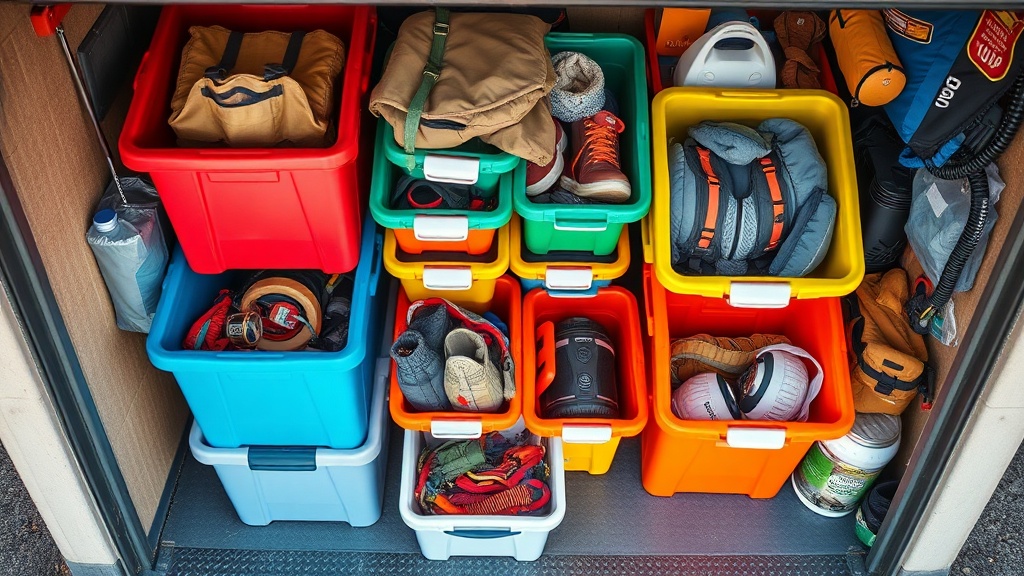
The Color-Coded Bin System That Stopped Me From Losing My Mind on Family Camping Trips

The Color-Coded Bin System That Stopped Me From Losing My Mind on Family Camping Trips
My family's entire camping setup fits into six labeled bins. Here's exactly how I organized it — and the one change that cut our packing time from two hours to twenty minutes.
I need to tell you about the trip that broke me.
It was our fifth family camping weekend. We'd just pulled into a state park campsite in Wisconsin — two cranky kids in the back, a trunk full of loose bags, and me standing in the parking area trying to remember which grocery bag had the headlamps and which one had the snacks.
Spoiler: I found the headlamps at 10 PM. Inside the cooler. Under the cheese.
That night, while my husband set up the tent using his phone flashlight (because the lantern was somewhere in the trunk abyss), I sat in the front seat with a notebook and did what I always do when something in my life isn't working: I made a system.
Why "Just Throw It in the Car" Doesn't Work With Kids
Before I had kids, camping packing was simple. Tent, sleeping bag, cooler, done. But with a 4-year-old and a 7-year-old, the gear list exploded:
- Extra layers because kids refuse jackets until they're shivering
- Activity supplies for the inevitable "I'm bored" at the campsite
- A first aid kit that actually has kid-appropriate stuff (children's Benadryl, character Band-Aids, tick removal tool)
- Backup everything — backup socks, backup pajamas, backup snacks
When you're dealing with 40+ items across cooking, sleeping, clothing, safety, and entertainment categories, "I'll just remember where I put it" is a lie you tell yourself at home and regret at the campsite.
The Six-Bin System (Our Exact Setup)
Here's what we use. Each bin is a specific color, and everyone in the family knows which color means what. Yes, even the 4-year-old. Especially the 4-year-old — she's the most militant about it.
Bin 1: RED — Kitchen & Cooking
Container: 27-gallon Sterilite tote, red lid
- Camp stove (Coleman Classic — it's not fancy, it just works every time)
- Two nesting pots, one cast iron skillet
- Utensil roll (I use a cheap knife roll from Amazon, $14)
- Plates, cups, bowls — all the same brand so they actually stack
- Dish soap, sponge, small drying towel in a gallon Ziploc
- Fire starters and long lighter
- Aluminum foil, trash bags
Rule: If it touches food preparation, it lives in the red bin. No exceptions.
Bin 2: BLUE — Sleep System
Container: Large duffel bag (blue, obviously)
- All four sleeping bags, compressed
- Sleeping pads (we use the self-inflating kind — I gave up on air mattresses after the Great Deflation Incident of 2024)
- Pillows from home (yes, we bring real pillows — this is not negotiable for me)
- One fleece blanket per kid
Rule: Sleep stuff stays together and gets loaded last so it comes out first at camp.
Bin 3: GREEN — Clothing & Layers
Container: One packing cube per person, all in a green dry bag
- Each person's clothes in their own labeled cube
- Extra warm layers in a separate "emergency warmth" cube
- Rain jackets clipped to the outside of the bag (accessible without unpacking)
- One full change of "car clothes" per kid in a Ziploc (for the drive home when everything else is dirty)
Rule: Dirty clothes go into a black trash bag that lives inside this bin. Clean stays separate from dirty, always.
Bin 4: YELLOW — Safety & First Aid
Container: Medium yellow dry box
- First aid kit (I built ours — the pre-made ones never have what you actually need)
- Headlamps (one per person plus a spare)
- Lantern
- Sunscreen, bug spray
- Emergency whistle per kid (on a lanyard they wear at camp)
- Camp knife, multi-tool
- Campsite reservation printout and park map
Rule: This bin rides in the backseat, not the trunk. You need to access safety gear without unpacking anything else.
Bin 5: ORANGE — Fun & Activities
Container: Small orange tote
- Nature scavenger hunt cards (laminated — trust me)
- Glow sticks for nighttime
- Card games in a waterproof case
- Binoculars
- Kid-sized fishing net for creek exploration
- Two paperback books per kid
- A small sketchbook and colored pencils
Rule: Kids can grab from this bin anytime without asking. It's their domain. Autonomy prevents whining — a project management principle that 100% applies to camping.
Bin 6: WHITE — Campsite Setup
Container: Large white tote
- Tent (or strapped to the top, depending on size)
- Ground tarp
- Camp chairs (four, strapped separately)
- Tablecloth and clips for the picnic table
- Small broom and dustpan (you will thank me for this one)
- Paracord and carabiners
- Mallet for stakes
Rule: This bin gets unloaded first. Campsite setup before anything else — the kids have somewhere to sit while we work.
The Packing Checklist That Changed Everything
The bins are half the system. The other half is the checklist taped inside each bin lid.
I printed a laminated packing list for each bin. Before every trip, we pull the bins out of the garage, open the lids, and check items off. If something is missing — like the sunscreen that migrated to the bathroom — we know immediately, not at the campsite at 6 PM when the mosquitoes arrive.
Each list also has a "RESTOCK AFTER TRIP" section at the bottom: items that get used up (fire starters, trash bags, sunscreen, snacks) so we refill the bins before they go back on the shelf.
This is the part that cut our packing time from two hours to twenty minutes. We're not "packing" anymore. We're just verifying that the bins are complete and loading them into the car.
How We Load the Car (It Matters More Than You Think)
Loading order, back to front:
- White bin (campsite setup) — goes in first, comes out first
- Red bin (kitchen) — heavy, goes on the bottom
- Blue duffel (sleep) — on top of red, pulled out at bedtime
- Green bag (clothing) — accessible from the side
- Cooler — last in the trunk so it's first out (keeps cold longer when loaded late)
- Yellow box (safety) — backseat, behind the driver
- Orange tote (fun) — backseat floor, between the kids
This loading order means we never have to move three things to get to the one thing we need. White comes out first because we set up camp first. Cooler comes out last from the trunk because food stays cold best when it's loaded closest to departure time and unloaded on arrival.
What I Got Wrong Before I Got It Right
A few mistakes I made that you can skip:
Mistake 1: Organizing by trip instead of by function. I used to pack "Friday bag" and "Saturday bag." Terrible idea. You need the sunscreen on Friday AND Saturday. Organize by what things ARE, not when you think you'll use them.
Mistake 2: Using identical containers. Our first attempt was four black bins from Costco. We labeled them with masking tape. The tape fell off on trip two. Color-coding isn't optional — it's the whole point.
Mistake 3: Not giving the kids ownership. The orange bin changed our dynamic. When the kids are bored, they don't come to me — they go to their bin. That's 30% fewer "what do we doooo" complaints, which I consider a major operational win.
The Real Cost
People ask if this system is expensive. Here's the actual breakdown:
- 4 Sterilite totes (various sizes): ~$40 total
- 1 large duffel: already owned
- 1 dry bag: $22
- 1 dry box: $18
- Packing cubes (set of 6): $16
- Laminated checklists (printed at home): $3 for laminating sheets
Total: around $100. For a system we've now used for 30+ trips. That's about $3 per trip for the privilege of not losing my headlamp in the cooler.
One Last Thing
I know some of you are reading this thinking "this is overkill." And you might be right — for you. But if you're the person in your family who ends up responsible for remembering everything, packing everything, and then finding everything at the campsite while someone else relaxes in a camp chair, this system is freedom.
It's not about being Type A. It's about making the mental load visible, shareable, and — most importantly — something you do once and then stop thinking about.
The bins sit ready in our garage. When we decide on a Friday afternoon that we want to camp this weekend, we're out the door in under 30 minutes. That's the real magic: spontaneity that only exists because of the system behind it.
Your gear doesn't have to match mine. Your bins don't have to be these colors. But pick a system, commit to it, and stop wasting your camping weekends looking for the headlamp.
It's in the cooler. It's always in the cooler.
— Priya